Recruiting
+ 38 098 701 08 98
In war, it is important to have powerful weapons, equipment, well-trained soldiers, reliable communications, and ammunition.
But even the most powerful weapons are of little use if you do not know what is happening around you.
Where is the enemy? What are they doing? What has changed? What can be expected next?
Military intelligence provides answers to these questions.
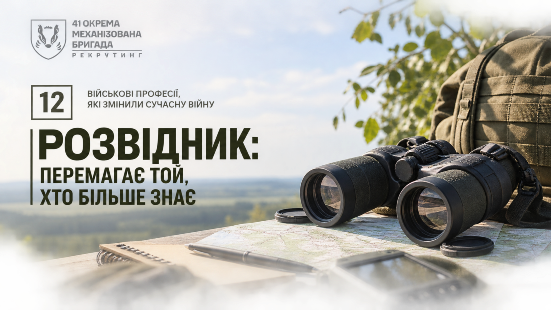
Modern warfare has once again demonstrated a simple truth: the advantage does not always belong to those who are stronger. Very often, it belongs to those who know more.
An Intelligence Soldier Is Not a Movie Hero
Movies often portray military intelligence personnel as soldiers who infiltrate enemy territory alone and carry out extraordinary missions.
In reality, military intelligence is much broader than that.
It is a large system involving people from many different specialties. Some gather information, while others verify and analyze it. Some work with technical equipment, while others operate unmanned systems.
Individual pieces of information must ultimately come together to form a clear picture.
That is why a modern intelligence soldier is not necessarily someone who resembles an action-movie hero. More often, it is someone who knows how to observe, think, and notice what others may overlook.
Seeing Does Not Always Mean Understanding
Modern warfare generates an enormous amount of information: drones, surveillance systems, maps, photos and videos, and reports from other units.
But having more information does not automatically provide an advantage. That information must be understood correctly.
Sometimes it is not enough simply to notice that something has changed. You also need to ask: Why did it change? What does it mean? How does it relate to other information?
That is why military intelligence particularly values attention to detail, analytical thinking, and the ability to recognize connections between separate pieces of information.
A single detail noticed at the right moment can influence a decision and the subsequent actions of a unit.
Technology Helps. People Make the Decisions.
Once, one of the intelligence soldier’s primary tools was simply their own eyes. Today, the possibilities are far greater.
A drone can transmit video. A device can record data. A computer can help process large amounts of information.
But technology has not removed people from this process.
Quite the opposite: the more information technology provides, the more important it becomes to have someone capable of evaluating it and understanding what it means.
Attention Matters More Than Being the Loudest Voice
A good intelligence soldier is not necessarily the person who talks the most.
Often, it is quite the opposite.
It is someone who knows how to listen, observe, remember, compare, and notice what others have missed.
In civilian life, these qualities may simply seem like personality traits. In military intelligence, they become professional skills.
If you enjoy working with information, looking for patterns, understanding maps, technology, or computers, there may be different roles within military intelligence that suit you.
Intelligence Works for Others
Intelligence personnel do not gather information for themselves.
That information is needed by commanders and other units to assess the situation and make decisions.
That is why successful intelligence work means ensuring that the right information reaches the people who need it at the right time.
Intelligence helps the military see.
And a military that can see can make better decisions.
You Do Not Have to Be Born an Intelligence Soldier
As with other military professions, much of the job can be learned through training.
People learn how to work with information and equipment, how to observe effectively, and how to distinguish what matters from what does not.
With experience, they begin to notice things they might previously have overlooked entirely.
That is why having no previous military experience does not mean this path is closed to you.
What matters much more is attention to detail, responsibility, the ability to learn, and a willingness to understand new things.
Those Who Know Have the Advantage
Modern warfare has become a war of technology. At the same time, it has become a war of information.
Having powerful weapons is not enough — you need to understand where and when they are needed.
Having modern equipment is not enough — you need to see and understand the environment in which it will operate.
That is what military intelligence is for.
It brings together individual pieces of a much larger picture so that others can see it clearly.
Because sometimes the most important advantage in war is not having more.
It is knowing more.