Recruiting
+ 38 098 701 08 98
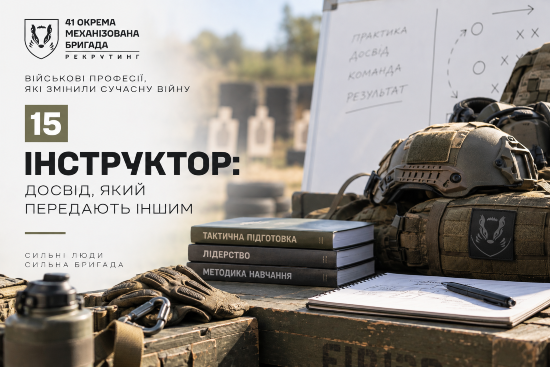
In the military, many things begin with training.
The first lessons. The first introduction to equipment. The first skills. The first mistakes. And almost always, there is someone nearby who has already walked this path before.
An instructor.
Their job may seem simple: teaching someone else what you already know. In reality, that is not enough. A good military instructor must not only know their profession — they must also know how to pass that knowledge on to another person.
In military service, many things can be learned from manuals. But some knowledge comes only through practice. A person has seen how certain things work in real situations, made mistakes, found better solutions, and accumulated their own experience.
At some point, that experience can become useful not only to them.
An instructor passes it on to other service members so they can master the necessary skills more quickly, better understand their work, and be better prepared to perform it.
At the same time, being a good specialist and being a good instructor are not always the same thing.
You can know your profession extremely well but still not know how to teach others. An instructor needs to explain complicated things in simple terms, recognize when someone has not understood something, explain it again in a different way, and give them the opportunity to try it themselves.
Sometimes an instructor needs to be demanding, and sometimes patient. This is especially important when working with someone who was a civilian only recently and is encountering an entirely new profession for the first time.
People learn differently. One person understands something the first time, another needs to see it again, while a third may ask ten questions. And that is completely normal.
An instructor's job is not to demonstrate how much they know. What matters is ensuring that the person they are training gains the knowledge and skills they need.
Modern warfare is constantly changing. New equipment, unmanned systems, technologies, and new approaches to carrying out tasks continue to emerge. Something that was relevant only recently may already need to be reconsidered today.
That is why instructors must continue learning as well. They follow changes, learn from the experience of others, improve their own knowledge, and then pass it on.
In fact, a good instructor remains a student even while teaching others.
People usually become instructors after gaining their own professional specialization and practical experience. First, a person learns, works, gains experience, and becomes a skilled specialist. Later, they may begin passing their knowledge on to others.
For some, this becomes the next stage of professional development in the military. You are no longer responsible only for how well you perform your own work, but also for how well you have prepared others.
The results of an instructor's work are not always immediately visible.
They can be seen in a trained service member — someone who arrived without certain knowledge or skills, learned them, and can now perform their work with confidence.
And over time, perhaps that person will begin teaching others as well.
Every experienced service member carries knowledge built through training, practice, mistakes, and their own decisions. That experience can be kept to oneself.
Or it can be passed on.
That is the strength of a good instructor. They do more than teach others. They ensure that accumulated experience is not lost, but becomes the experience of those who come next.