Recruiting
+ 38 098 701 08 98
In a large military unit, hundreds of different processes are taking place simultaneously. Some people carry out missions, while others operate equipment, maintain communications, repair vehicles and machinery, transport supplies, keep records, plan, or organize the work of others.
For all of this to function as a single system, effective command, coordination, and a constant exchange of information are essential. Headquarters are an important part of this system.
A brigade includes infantry, artillery, tank crews, unmanned systems, reconnaissance, communications, engineering units, medics, maintenance personnel, drivers, logistics, and many other areas. Everyone performs their own role, but all these processes need to be connected and coordinated.
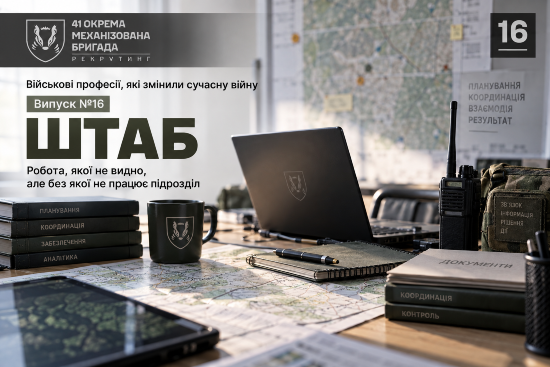
Working at headquarters is not a single profession. It involves documentation, record-keeping, planning, organization, information management, and coordination. Everyone has their own area of work and their own responsibilities.
The modern military deals with enormous amounts of information every day. It must be received, verified, organized, and passed on to those who need it, while ensuring that important matters do not get lost among hundreds of others.
For many military specialties today, a computer is just as much a working tool as a wrench is for a mechanic.
And this is where civilian professions and skills often become especially valuable.
Administrators, accountants, lawyers, managers, operators, analysts, clerks, and IT specialists can all bring useful experience to the military. Attention to detail, responsibility, and the ability to work with documents, spreadsheets, digital systems, and large volumes of information are particularly valuable.
This work is not always visible. But an error in a document, a missed deadline, or lost information can create problems for many people. That is why checking details, avoiding mistakes, passing information on in time, and seeing tasks through to completion are also important parts of military work.
If someone looks at military professions and thinks, “I’m not a driver, a mechanic, or a medic. What could I do in the military?” it is worth considering their own civilian experience.
Can you work confidently with a computer? Handle documents? Organize work? Use spreadsheets? Analyze information and quickly find what is needed among large amounts of data?
These skills are needed in the military too.
Sometimes there is no need to completely change your profession. It may be enough to apply your existing knowledge and experience in a different environment.
Headquarters work is not always visible from the outside. There is no single universal task or profession here. Behind every area are service members responsible for their part of the overall work.
A computer, a phone, a map, a document, or a spreadsheet — these are working tools just like any others.
And when many different people and units operate as one, it is not only because of the work of those who are directly visible while carrying out missions. It is also the result of the daily work of the people who ensure command, coordination, and effective interaction.
That is how headquarters work.