Recruiting
+ 38 098 701 08 98
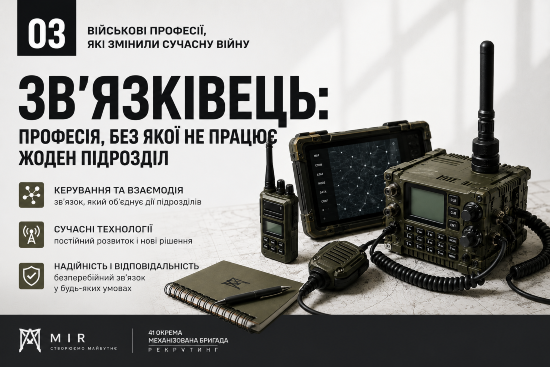
When people talk about modern warfare, drones, artillery or armored vehicles are often mentioned. But there is a specialty without which all of them will not be able to work as a single system.
This is military communications.
It is thanks to communications officers that commanders manage units, orders are transmitted, military actions are coordinated and interaction between different units is ensured. If the connection disappears, it becomes much more difficult to perform combat tasks.
That is why the signalman is one of the key professions of the modern army.
It is much more than a walkie-talkie.
Many people imagine a signalman as a person who simply works with a radio station. It combines various means of communication, equipment and specialists that ensure its smooth operation.
Today, this specialty is constantly developing along with technologies, therefore it needs responsible people who understand their work well.
Different specialists are needed here
Communication forces combine many different directions. For some positions, it is enough to complete the necessary training, while others already require specialized knowledge and practical experience.
That is why this specialty may be of interest to people who have an education or have worked in the field of telecommunications, electronics, computer networks, IT or radio communications.
If you already have such knowledge, it can be an important advantage during the service.
Knowledge that matters
Modern warfare relies more and more on technologies. That is why professional communicators remain one of the most valuable specialists in the military.
If you have the relevant knowledge, want to apply it where it really matters, and be part of a team whose work depends on the success of combat missions, military communications can be your field of service.