Recruiting
+ 38 098 701 08 98
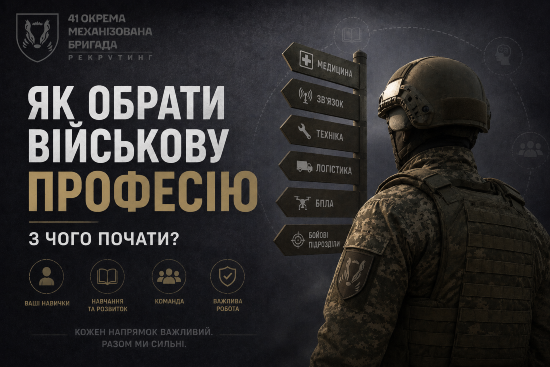
Many people who are thinking about the service for the first time ask themselves the same question: “Who can I be?”
Often it seems that the choice is small. In fact, a modern mechanized brigade is a large team in which military personnel of a wide variety of specialties work. Here we need not only those who directly perform combat tasks, but also those who ensure the work of units, maintain equipment in good condition, organize communications, provide medical assistance, deal with logistics and perform many other important tasks.
When choosing a military profession, you should first of all honestly answer a few simple questions. What skills do you already have? What did you do before? What do you like to do? You may have worked as a driver, mechanic, electrician, medic, cook, construction worker, or computer savvy. All this can be useful during the service.
At the same time, do not worry if you do not have military experience. For many specialties, the most important are the desire to learn, responsibility, discipline and willingness to work in a team. Necessary knowledge and practical skills are acquired during training.
Modern military service is a constant development. Military personnel learn, gain new experience and improve their skills. If, over time, there is a desire to develop in a different direction, and there is also a need for the unit, appropriate training and an opportunity, a serviceman can master a new specialty. That is why the desire to learn and develop is always a great advantage.
It is equally important to understand that modern military service is a team effort. Each direction has its own meaning, and the result depends on the coordinated interaction of many people. That is why there are no "important" and "unimportant" professions - each of them is an important part of the common cause.
If you have not yet decided on a specialty, that is completely normal. This is what recruiters work for. During the conversation, they will help you better understand which areas may match your skills, experience and wishes, and they will also answer the questions you are interested in.
You don't have to try to find the answers to all the questions yourself. The first step is to contact the recruiter, tell about yourself, ask your questions and get the necessary information. After that, it is much easier to make a decision.
Service does not begin with choosing a position. It begins with a decision to take the first step and learn more. And finding a career path that best matches your skills, experience, and desire to grow is much easier when you have complete information.